Some of the main pillars of the MSCA actions are the dissemination and public engagement. The fellows’ task is also to share their experiences and spread knowledge of the Marie Curie actions, also within the scientific world. In the Italian geological and hydrogeological communities, European individual fellowship fundings are little known and often considered as a too competitive contest.
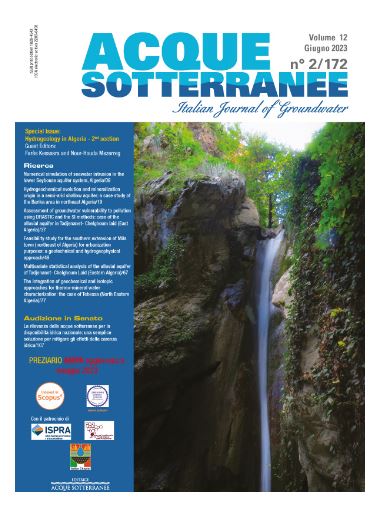
In collaboration with my colleagues Diego di Curzio (University of Delft, Nederland), Eloisa di Sipio (University of Padua, Italy) and Viviana Re (University of Pisa, Italy) we wrote a column in June 2023 on “Acque Sotterranee – Italian Journal of Groundwater” (IJG) to better describe the meaning of the MSCA actions. IJG is the reference magazine for Italian hydrogeologists, publishing national and international studies as well as update columns on research and work activities in the field of hydrogeology in open access mode.
In this column we wanted also to summarize the spirit, types and difficulties of MSCA actions for individual fellowships, promoting the participation of early career Italian hydrogeologists showing that already 4 of us got the fundings to developed their international research.
Short summaries of the funded projects were also included, starting from Bir Al-Nas (2014) to MICROLIFEPAQS (2022) and of course SPONGE too!
The original Italian version of the column can be freely read at this link https://www.acquesotterranee.net/acque/article/view/663
Otherwise, a translated version in English is reported below:
In recent years an increased involvement of research groups within projects funded by the European Commission was observed, mostly within large joint projects. These projects are excellent growth opportunities from a personal and scientific point of view, since they give the opportunity to the early career researchers to get knowhow and exchange ideas and experiences with colleagues and professors operating in other Countries with different research background. The role of early career researchers is very important within this type of fundings, especially to develop the research but they play a very marginal role in acquisition of the funds.
Within many European funding opportunities for research, there is a category designed specifically for researchers at the beginning of their career, regardless of age or Country of origin. This type of action is the Marie Skłodowska-Curie Postdoctoral Fellowship aiming at support individually a researcher and her/his project idea. One of the aims of this action is the promotion and support of research from any kind of discipline within an international experience. There are not limitations of topics, ranging from social sciences and humanities to environmental sciences, passing through mathematics and physics, up to economic sciences.
Only two criteria must be satisfied to participate to the action:
- Candidates that submit the proposal must have already obtained the P.h.D. or at least they must already have successfully defended their doctoral thesis on the deadline of the call.
- Candidates must have maximum of 8 years of Post-doc experience on the deadline of the call. However, experiences outside of research and interruptions of career (for example due to parental leave) must be excluded from this calculation.
Actions within the Marie Skłodowska-Curie Postdoctoral Fellowship (MSCA-PF) can be distinguished into two large categories that differ in duration of the research and choice of countries where to carry out the research:
- European Fellowship (EF): this type of action allows researchers to carry out their research at an European Institution (Host Institution) located in a Country member or associated to the Horizon Europe programme. The research period is 24 months, and the main objective is to acquire new skills and strengthen to improve the fellow’s curriculum at an international level. The action is open to researchers who move within Europe or who they arrive from other continents, with the limit that the fellow can choose a country where he/she has not been for more than 12 months in the last 3 years. To for example, anyone who would like to present a project this year with Italian Host Institution must not have resided or carried out his research activity in Italy for more than 12 years months between 09/13/2020 and 09/13/2023.
- Global Fellowship (GF): This funding is aimed at researchers who want to acquire new knowledge e to gain experience through a research project involving a period of 24 months in a non-European research Institute and a return period of 12 month back in Europe, to relocate and consolidate the acquired skills. The researcher does not have to work for more than 12 months in the last 3 years in the non-European Country where the Partner Institution is placed. I’m not for GFs preclusions are foreseen regarding the choice of Host Institution.
MSCA-PF are generally very competitive both due to the large number and the high quality of projects presented. In 2022, 7044 proposals were submitted within the MSCA-PF actions (6334 EF and 710 GF) and approximately only 17% got funded, according to a roughly budget of €257 million. The percentage of funding was even lower in 2021 when 8356 applications were submitted the against the same financing budget (only 14% of the projects got funded). This is only an average estimation within all panels (topics). Focusing on the panel ENV (Environment and geosciences), which is the most relevant to the hydrogeologists, we can see that approximately 850 projects were presented within the EFs in 2022. 21.1% of which have not reached the minimum threshold for eligibility (score < 70/100). Among the remaining 668 research projects, 150 were funded (around 18% of the total) corresponding to score equal or higher than 92.6/100. The GF proposal submitted in the same panel were 98, 13 of which do not have reached the minimum threshold. Even in this case however the percentage of projects that obtained funding is very low (around 22%) with a minimum score of 94/100.
If a proposal has not reached the funding, it can be resubmitted in the subsequent call, as long as it has reached the minimum threshold in the panel. The proposal that have achieved a rating of 85 or higher will receive a recognition from the European Commission called “Seal of excellence”. This award certifying goodness of the proposal, and may be useful to get a smaller funding. In fact, several Italian and European Host Institutions have started to provide a financial support for researchers who obtained the Seal of Excellence until the next call. We invite you to contact the research office of the organization you have chosen as Host Institution to require more information about this opportunity of financial support.
Despite the high competitiveness of this type of action and the small number of early career hydrogeologists, we count 4 winners of MSCA-PF actions (2 GF and 2 EF) within the ECHN-Italy group. Starting from Prof. Viviana Re’s pioneering attention to internationalization in 2012 up to the Diego Di Curzio’s project in 2022, the early career Italian hydrogeologists received funding for the following projects:
Viviana Re – GF – FP7
Title and acronyms: Bottom-up IntegRated Approach for sustainabLe grouNdwater mAnagement in rural areaS (Bir Al-Nas)
Host Institution: Università Ca’ Foscari, Venezia (Italia)
Partner Institution: National School of Engineering of Sfax, Sfax (Tunisia)
Starting and finishing dates: 01/10/2013 – 30/09/2016
Abstract: Groundwater resources represent the largest volume of all unfrozen fresh water on Earth. However, the knowledge and understanding of this precious resource is very little, if compared to surface water, especially to the general public and policy makers. Indeed, groundwater resources if carefully managed can make a significant contribution to meet increasing water demand, agricultural needs and to adapt to global climate change, particularly in coastal regions. For this reason it is of paramount importance to promote groundwater protection and to raise awareness on its crucial role in sustaining human activities and wellbeing worldwide. Within these emerging needs, Bir Al-Nas (Bottom-up IntegRated Approach for sustainabLe grouNdwater mAnagement in rural areaS) project’s overall objective is to develop a replicable example of integrated approach for science-based groundwater management practices, by studying the aquifer system in the Cap Bon Peninsula (Tunisia). This region has been chosen as a case study being representative of increasing global water scarcity and aquifer overexploitation issues in coastal areas. The overall objective is meant to be achieved through an integrated hydrogeochemical and social analysis finalized to obtain robust and reliable information for providing advices and supporting integrated management practices for rural development.
Website: https://biralnas.wordpress.com/
Eloisa di Sipio – EF – H2020-MSCA-IF-2014
Title and acronyms: Improving Thermal Efficiency of horizontal ground heat exchangers (ITER)
Host Institution: Friedrich-Alexander University of Erlangen- Nürnberg (FAU), Erlangen (Germany)
Partner Institution: Department of Geology, GeoZentrum NordBayern (Germany)
Starting and finishing dates: 01/11/2015 – 31/10/2017
Abstract: Since heating and cooling demands constitute almost 50% of the final energy demand in Europe, the development of geothermal energy systems and especially shallow geothermal solutions, reveals a huge potential in providing thermal energy for residential and tertiary buildings, thanks also to its local availability, manageability and flexibility. Research and innovation actions in this topic are focused on finding new technical solutions, developing emerging technologies and improving heat transfer efficiency of existing systems. There is required, on the one hand, a better knowledge of the thermal properties of the ground and, on the other, the efficient implementation of thermal energy transfer technologies. ITER Project (Improving Thermal Efficiency of horizontal ground heat exchangers) totally agrees with these purposes. In fact, the overall aim of ITER is to ensure the sustainability of ground coupled heating-cooling systems and especially the horizontal ground heat exchangers systems. Key challenges are (i) to enhance the heat transfer of the ground surrounding the pipes creating thermally enhanced backfilling material (TEBM) suitable for horizontal systems; (ii) to assess the performance and the environmental impacts of new promising technological solutions as helix systems with and without TEBM; (iii) to monitor the results over time through direct measurements and numerical simulation. Thermal laboratory measurements and in situ monitoring of existing and duly installed horizontal systems were performed by close cooperation between host institutions and non-academic partners.
Website: https://cordis.europa.eu/project/id/661396
Stefano Viaroli – GF – H2020
Title and acronyms: Surface runoff as source of microplastics and emerging contaminants in megacities aquifers – SPONGE
Host Institution: Università di Pisa, Pisa (Italy)
Partner Institution: Southern University of Science and Technology (SUSTech), Shenzhen (China)
Starting and finishing dates: 11/11/2022 – 10/11/2024
Abstract: SPONGE aims at contributing to improve safe recharge of urban aquifers expanding the Sponge city strategy, in which runoff water could be collected not only to reduce waterlogging but also to foster the recharge of stressed aquifers. In this framework, great attention must be paid to water quality by focusing on microplastics contamination and its relationship with other organic and inorganic emerging contaminants. The main expected results are: (i) quantification of microplastics contamination in rain and runoff water, assessment of their variability in time and evaluation of the relationship between microplastics and other contaminants; (ii) definition of microplastics and emerging contaminants occurrence in groundwater through the realization of experimental models; (iii) evaluation of the stored runoff water as a source to increase the resilience of the urban aquifer to the groundwater scarcity.
Website: https://wordpress.com/home/sponge-msca.org
Diego di Curzio – HORIZON-MSCA-2021-PF-01
Title and acronyms: Modeling mICRObial LIFE in Polluted AQuiferS (MICROLIFEPAQS)
Host Institution: Delft University of Technology, Delft (The Netherlands)
Partner Institution: Technical University of Denmark, Kongens Lyngby (Denmark)
Starting and finishing dates: 15/10/2022 – 14/10/2024
Abstract: Groundwater pollution is a significant threat to human health and ecosystems and one of the leading causes of limited access to good-quality water resources worldwide. Biodegradation is an effective means to remove chemicals from the environment, and several remediation techniques benefit from degrading bacteria to eliminate pollution from aquifers. Reactive Transport Models (RTMs) have proved to be valuable tools to support remediation. However, efforts made so far to model biodegradation in polluted aquifers have been incomplete, as they did not thoroughly consider that microorganisms’ behaviour in groundwater depends on their metabolism and physical interaction with the porous medium. The MICROLIFEPAQS project aims at implementing a novel and interdisciplinary approach for pollutant biodegradation modelling as reliable support for groundwater remediation optimisation. Modern and newly collected microbiological omics data will constrain RTMs of degrading bacteria with information about their metabolism. Moreover, microorganisms will be considered as reactive biocolloids moving in the subsoil. This omics-informed RTM of biocolloids will be tested in a contaminated test site, considering naturally occurring bacteria or injected/stimulated for bioaugmentation/biostimulation. As the United Nations and European Union strive to eliminate pollution to reduce the risk for human health and ecosystems and secure safe water resources and sanitation for everyone, this project will also contribute to this global challenge.
Website: https://cordis.europa.eu/project/id/101064993
The European Commission has allocated 260 million € for the 2023 call. The writing of a good proposal must certainly start from an excellent and well contextualized scientific project, so as to make it particularly solid and captivating. However, the proposal does not only concern the research activity, but also requires (i) attention to mobility and scientific growth of the fellow and (ii) a robust and effective strategy for dissemination and communication, aimed not only at the academic but also to lay society.

 SPONGE - Surface runoff as source of microplastics and emerging contaminants in megacities aquifers