Each research is different, but we can always recognize the main steps: definition of an initial idea, data collection, data processing and obtaining the results. However, this is not the last step on the road. This is where some challenges begin, sometimes they are more difficult than the experimental part. The publication and dissemination of results are two fundamental aspects in the life of a researcher.
The publication of scientific articles in high ranked journals is essential for the personal growth of a researcher, allowing him/her to obtain a robust curriculum and wide reputation. Dissemination of results out from scientific events (such as during national and international congresses) it is equally important, because it allows to spread knowledge to an ever wider audience.
The integration of social sciences not only in the dissemination phase but also during the implementation of the research itself is acquiring an increasingly central role, through transdisciplinary approaches such as Socio-Hydrogeological (Re, 2015; https://link.springer.com/article/10.1007/s10040-015-1284-8). The identification of the main stakeholders is a fundamental step in this type of approach. Defining all the people, agencies and companies involved in the management or use of water, for example, is necessary to understand power relations and the effects they have on end users. For this reason, it is important to get in touch with all possible stakeholders and make them aware of the importance of our research.
There are several associations that aim to raise awareness among the population and water managers about the problems that we are facing on a daily basis and that will be increasingly pressing in the (near) future. Pollution, especially from emerging contaminants, and global climate change will lead to less and less water available and of ever lower quality. These effects will hit the most economically fragile population more acutely in incoming countries. Among the numerous associations, the missions of the American Groundwater Trust (AGT) (https://agwt.org/) are:
- Communicate the environmental and economic value of groundwater
- Promote efficient and effective groundwater management
- Showcase groundwater science and technology solutions
- Increase citizen, community and decision-maker awareness
- Facilitate stakeholder participation in water resource decisions
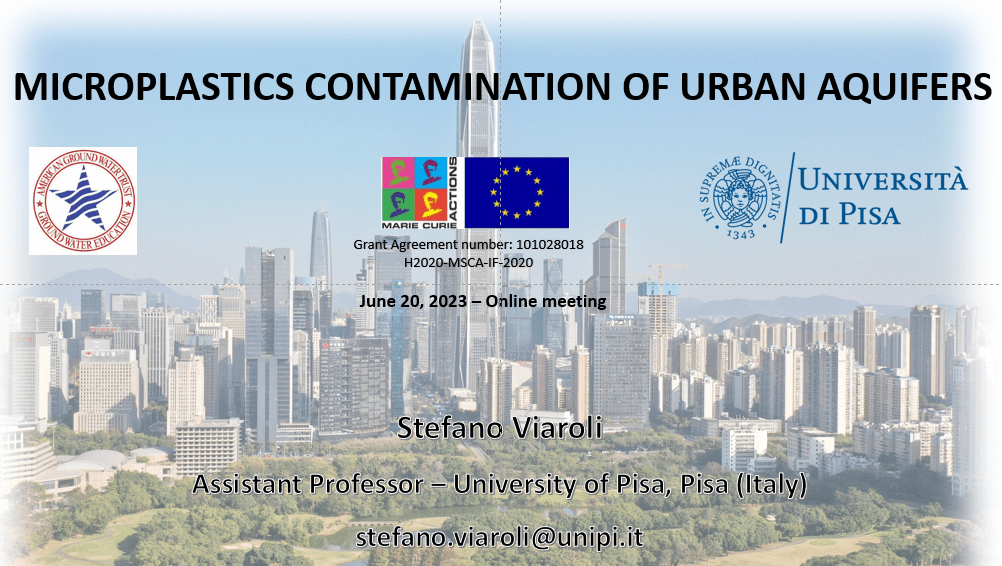
Among the many activities carried out by AGT, I was invited to give a small contribution to a webinar day reserved for groundwater professionals and water managers dedicated to Microplastics in Groundwater. This topic is still very sectorial and very often outside the scientific community there is unfounded news and alarmism.
In this webinar series, background information on the nature, dynamics and environmental and toxicological risks related to microplastics in groundwater were introduced. My contribution was to highlight the high risk of contamination in urban aquifers, especially for shallower aquifers. In the urban environment, there are many sources of possible microplastic contamination, especially when urban runoff water infiltrates. Risks to human and environmental health increase in urban areas because microplastics have the ability to take on other contaminants such as antibiotics and heavy metals. These contaminants are usually in very low concentrations, but their adsorption on microplastics can lead to a concentration effect resulting from the accumulation of MPS.
It was a pleasure to have been able to make my small contribution to the discussion and I hope to be able to contribute more strongly in the future when we have new results to discuss.

 SPONGE - Surface runoff as source of microplastics and emerging contaminants in megacities aquifers